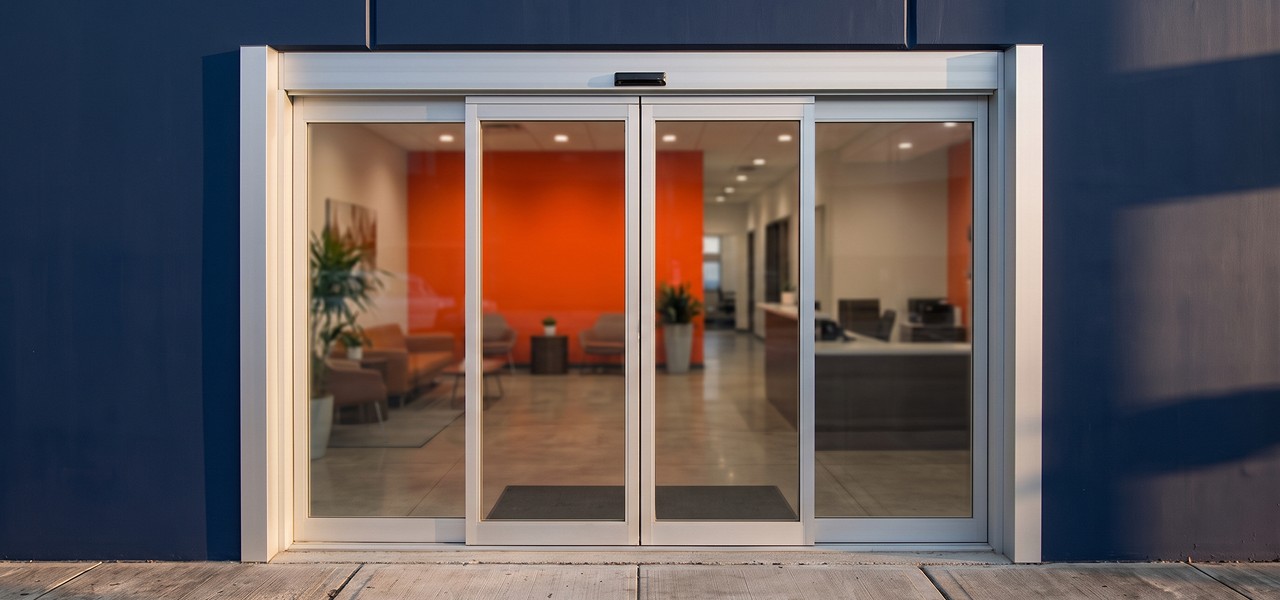
A door should never make someone question whether they can get to the other side.
For commercial buildings, creating intuitive passage does not always require an automatic opening. The ADA generally does not mandate automatic operators. Instead, it establishes spatial and operational standards for how people approach, interact with, and transition through an opening.
When specific ADA requirements such as opening dimensions, maneuvering clearances, proper hardware mounting, and operating forces are fully met, a manual door can support safe and independent movement without needing automation.
The key is understanding which ADA requirements apply to the opening and when those requirements can be met with a manual door versus an automatic operator.
Understanding these manual baseline standards is critical because an automatic door operator is often introduced specifically when a manual door cannot meet these spatial, clearance, or operating force requirements, or when high traffic volumes demand automated assistance.
What Exactly Does the ADA Require?
For a door to deliver effortless operation,e every surrounding detail must function as a unified system.
Clear Width and Maneuvering Space
Under the 2010 ADA Standards for Accessible Design, doors along an accessible route generally must provide at least 32 inches of clear opening width.
Approach routes must allow ample space to reach controls, actuate hardware and move through comfortably. Surrounding walls, spatial geometry and door swings directly shape that physical experience.
Hardware, Thresholds, and Opening Force
Handles, pulls, latches and locks generally must be mounted between 34 and 48 inches above the finished floor and operable with one hand without tight grasping, pinching or twisting of the wrist.
Threshold heights, closing speeds and opening forces dictate accessibility. Interior manual doors generally require no more than five pounds of force, ensuring physical effort does not become a barrier to entry.
When these elements work together seamlessly, manual openings provide comfortable, accessible movement without requiring automation.
When Could an Automatic Door Be Required?
While the ADA does not universally require automatic operators, specific architectural contexts, local building regulations and user flows often make automation the ideal solution.
State, Local, and Project Requirements
State or municipal codes, accessibility settlements, and specialized building programs may mandate automatic entry. Facility leadership should evaluate the complete regulatory context alongside base ADA guidelines.
Automatic operators are frequently integrated to elevate the occupant experience in high-density facilities, healthcare environments or spaces serving people with diverse mobility needs.
Automatic Doors Have Their Own Requirements
Adding an automated operator is not a standalone quick fix. It requires looking at the entrance as an interconnected environment where safety, access and structure align.
Full-powered automatic systems adhere to ANSI/BHMA A156.10, whereas low-energy and power-assisted assemblies follow ANSI/BHMA A156.19. These standards govern critical touchpoints including sensor zones, opening speeds and clear communication signage.
The chosen operator must integrate cleanly with structural frames, locking mechanisms, activation sensors and daily usage patterns.
How Do You Determine Whether an Automatic Door Is the Right Solution?
Effective evaluation starts by viewing the whole opening rather than selecting hardware in isolation. Comprehensive planning considers:
- Opening type, dimensions and door swing
- Frame, threshold and existing hardware
- Traffic volume and operating cycles
- Activation controls and safety sensors
- Electrical service and standby power
- Access-control and fire-alarm connections
- Fire rating and egress requirements
- Environmental exposure and building pressure
This approach clarifies whether access is best optimized through hardware tuning, closer calibration, threshold adjustments, automated operators, or structural refinements.
Find the Right Way Through
The ADA does not dictate a single product response for commercial entrances. Its true intent is ensuring unhindered human movement, which well-engineered manual openings can readily achieve.
Every entrance shapes how people experience a facility. Top Door helps evaluate your building openings, diagnose access challenges, and implement integrated manual or automatic door solutions tailored to your operational goals.